Category Archives: writing

Hướng dẫn viết câu phức ielts writing

Câu phức

Complex sentence là câu chứa 1 mệnh đề độc lập và ít nhất 1 mênh đề phụ thuộc (subordinate clause)

Ví dụ

Parks should be replaced by new buildings   because there is not enough accomodation for residents.

Parks should be replaced by new buildings   là mệnh đề độc lập

There is not enough accomodation for residents là mệnh đề phụ thuộc vì chứa subodinating conjunction (because) ở phía trước

Có 4 loại từ nối khác nhau trong câu phức

  1. Because, since, as: đưa ra nguyên nhân

Ví dụ: Parks should be replaced by new buildings   as there is not enough accomodation for residents.

  • Though, although, while, even though: đưa ra sự tương phản

Ví dụ: Many people go traveling though corona virus outbreak has been widespread

  • After, as, since, before, until, when, while: Chỉ thời gian hay chuỗi sự kiện

Ví dụ: the living area has been polluted since a factory was built nearby

  • If, unless: đưa ra điều kiện

Ví dụ: I will study abroad unless I pass the university entrance exam

Thầy Anh IELTS

thầy anh ielts

Bài viết task 1(dạng bài table): #1

You should spend about 20 minutes on this task.

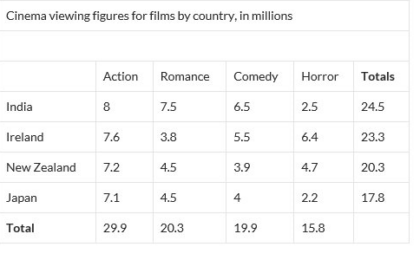
The table below shows the cinema viewing figures for films by country, in millions.

Summarise the information by selecting and reporting the main features, and make comparisons where relevant.

Write at least 150 words.

Cinema viewing figures for films by country, in millions
ActionRomanceComedyHorrorTotals
India87.56.52.524.5
Ireland7.63.85.56.423.3
New Zealand7.24.53.94.720.3
Japan7.14.542.217.8
Total29.920.319.915.8

Điền các từ bên dưới vào “show more”

than          30 million     On the other hand

come next        most popular           compares

Model answer

The table

compares
four countries in terms of the number of people who watch four different genres of film at the cinema: Action, Romance, Comedy and Horror.

The table indicates that more Indian people watch films at the cinema

than
the other three nationalities. In all four countries, Action is the
most popular
genre of film. The total number of viewers for action films is nearly
30 million
and in each country about 7-8 million people watch them.

Not many people like watching horror films at the cinema compared to the other genres of film. In India and Japan only 2-2.5 million people watch horror films but they are more popular in New Zealand and Ireland.

On the other hand
, romance films are very popular in India with 7.5 million viewers but it is not as popular in the other countries. New Zealand and Japan
come next
with 4.5 million viewers each.

(152 words)

Bài mẫu task 1 band 8

The chart compares the changes that took place between 2001 and 2006 in relation to the percentage of overseas students who graduated from universities in Canada. In 2001, the proportion of students from other countries who graduated in Canada ranged from three percent in Ontario to seven percent in New Brunswick. Nova Scotia had the second highest percentage at 6.5. Five years later, the figures for most provinces had risen by two to three percent, with the exception of Alberta. There, figures fell by one percent to just over four percent. A closer look at the chart reveals that significant growth occurred in New Brunswick, where the figures rose from seven to just under 12 percent. However, the biggest increase took place in British Columbia, where the percentage of graduates more than doubled,  reaching almost 11 percent in 2006. over this five-year period, some parts of Canada experienced a considerable increase in their proportion of overseas graduates, although New Brunswick remained  the province with the highest percentage overall

Bài mẫu band 8.0+ cho đề thi ngày 14/1/2016

Bài mẫu band 8.0+ cho đề thi ngày 12/12/2015

Topic:
People should follow the customs and traditions when people start to live in a new country. To what extent do you agree or disagree?

Sample band 8.0+

Upon commencing(1) a new life in a foreign country, people often face a dilemma(2) of whether they should stick to their cultural values or adhere to(3) the local lifestyle. Although living up to the standards(4) of one’s cultural background is legitimate on a certain level, I still believe that adaptation to the host country’s traditional practices(5) is sorely essential to immigrants. 


On the one hand, I agree that under various circumstances the adoption of new ways of living seems to be a headache, especially when it comes to long-standing values and religious matters(6). For example, an Asian family who has moved to the US would find public kissing highly inappropriate as they were taught how to express their emotions differently during their early phase of childhood. Such a standard has been profoundly imprinted on(7) their minds and can hardly be compromised. Additionally, the existence of unique cultural beauty within immigrants’ communities would be put at stake(8). When people are exposed to foreign lifestyles(9) every day, there is a chance of complete cultural assimilation(10) which potentially leads to the disappearance of traditional beliefs and behaviors among certain groups of expatriates(11).


On the other hand, I am inclined to the idea of immigrants’ adjustment(12) to their way of living in order to fit in the local community. The first point worthy of note is that such adaptation would help those people integrate(13) more quickly into the new setting. Obviously if a person leads a bizarre lifestyle(14), he will not be able to get on well with(15) his neighbors.Compliance with(16) the host nation’s social norms and conventions(17) can also eradicate the worry of social conflicts(18). Expatriates who are unwilling to adhere to the new cultural ideas and behaviors might have to face the hostility(19) from the locals and suffer from the sense of isolation(20) from society. 


In the light of both possible responses to such the matter of cultural adherence from immigrants as analyzed above, it seems to me that expatriates should learn to adapt themselves to live in harmony(21) in the exotic community bycomplying with(22) its traditional conventions. 
(348 words)

Useful vocabulary & expressions:
1. To commence sth: Bắt đầu cái gì đó
2. To face a dilemma: Đối mặt với tình huống khó xử
3. To adhere to: Tuân theo cái gì
4. To live up to the standards: Sống theo chuẩn mực nào đó
5. Adaptation to the host country’s traditional practices: Sự thích ứng với những tục lệ truyền thống của quốc gia mới
6. Long-standing values and religious matters: Những giá trị lâu đời và những vấn đề tôn giáo
7. To be imprinted in/on: Hằn sâu vào tâm lý ai đó
8. To be put at stake: Trong tình hình nguy hiểm
9. To be exposed to foreign lifestyles: Tiếp xúc với lối sống nước ngoài
10. Cultural assimilation: Sự hòa nhập văn hóa
11. Expatriate: Người di cư
12. Adjustment: Sự điều chỉnh
13. To integrate into: Hòa nhập vào cộng đồng
14. To lead a bizarre lifestyle: Có lối sống kì lạ
15. To get on well with: Hòa đồng với ai đó
16. Compliance with: Sự tuân theo cái gì
17. Social norms and conventions: Những ý niệm
18. Hostility: Sự hằn học
19. The sense of isolation: Cảm giác bị cô lập
20. To live in harmony: Sống hòa hợp
21. To comply with: Tuân theo cái gì

Mẫu bài thi band 8 ngày 17.6

Topic:
In many countries, government spent a large amount of money on improving internet access. Why is it happening and do you think it is the most appropriate use of government money?

Bài mẫu band 8.0

A huge proportion of national budget is allocated to providing people with easier access to the Internet. There are several reasons for such spending and, in my view, this is not the most suitable way to use state money.

The government understand how the Internet benefits the lives of their citizens and also the limitation of access to the network in a number of places across their countries. The Internet has proven powerful in dispensing educational services and general knowledge about all aspects of life, not to mention the fact that it could facilitate communication between even continents. There is no arguing why governments pay much heed to the development of the network, just as to boost the overall quality of life for their people. Additionally, perhaps the inaccessibility of the Internet in many areas, especially disadvantaged ones for which mountainous villages in Vietnam could be brought up as a prime example, has the government draw a conclusion to pour their money into improving the Internet.

Much as those analyzed points above, I still believe large financial spending on such a field could, sometimes, be seen as unproductive or even counter-productive. In fact, only half of the world population has Internet connection; and even if the government were able to expand the network, it would be, I believe, hardly reachable for the rest of the world for the time being. The result would not be equivalent to the enormous amount of governmental funding. Instead, there are some other areas that authorities could invest in as a pre-requisite complement before supplying a widespread network. Constructing schools and deploying qualified teachers to areas that are used to the absence of the Internet and are unaware of the benefits it might offer could be more promising.

In conclusion, there are two main explanations for governments’ special attention to improving the Internet access; and I think this is not the most optimal way to spend money.

(322 words)

Useful vocabulary:

1. A huge proportion of national budget: Một phần lớn ngân sách nhà nước

2. To dispense educational services and general knowledge about all aspects of life: đem đến những dịch vụ giáo dục và kiến thức chung về tất cả các khía cạnh của cuộc sống

3. To pour their money into improving the Internet: Đổ tiền vào nâng cấp Internet

4. To be equivalent to the enormous amount of governmental funding: Cân xứng với khối lượng kinh phí khổng lồ từ chính phủ

5. To be used to the absence of the Internet: Quen với việc không có Internet

Mẹo làm bài writing part 1

Kiểm tra lại sau khi viết xong bài là rất quan trọng nhưng nhiều người phàn nàn rằng không có đủ thời gian. Bạn có thể làm công đoạn này hiệu quả hơn bằng cách kiểm tra bài làm khi luyện tập và ghi ra 4-5 lỗi thường mắc. Sau một thời gian, bạn sẽ nhận ra đâu là lỗi mình hay mắc nhất và nhanh chóng khắc phục.

2. Đọc hướng dẫn một cách cẩn thận

Tưởng chừng như đây là việc ai cũng làm nhưng lại là một trong những sai lầm phổ biến nhất của người thi trong bài viết 1.

Hãy dành một phút để đọc đề bài vài lần và thực sự hiểu nó đang yêu cầu bạn làm gì. Luyện tập cũng sẽ giúp bạn làm quen với các loại yêu cầu khác nhau của bài viết 1 và giúp bạn tiết kiệm thời gian trong khi thi.

3. Diễn giải lại câu hỏi theo cách khác

Bạn sẽ mất điểm nếu sao chép các từ trong đề bài vào bài viết của mình. Người chấm sẽ nhìn xem bạn có diễn giải lại câu hỏi theo cách khác không. Để có thể viết lại câu, bạn chỉ cần đơn giản sử dụng các từ đồng nghĩa thay thế những từ quan trọng.

Không nên sao chép các từ sử dụng trong đề bài vào bài viết của mình.

Ví dụ:

Đề bài: The graph below gives information about cinema attendance in the UK between 1998 and the present, with projections to 2018.

Cách diễn giải lại: The diagram shows data of movie-goers in the United Kingdom from 1998 until now, with forecasts up to 2018.

Bạn có thể thấy nghĩa của 2 câu không khác nhau, chỉ có từ là thay đổi. Câu viết lại này nên ở đoạn đầu tiên trong bài viết.

4. Sử dụng dấu hiệu thông báo

Có những từ và cụm từ này giúp người chấm biết được bạn đang viết về cái gì. Chúng đôi khi được gọi là “từ nổi”. Ví dụ: ‘The graph/table/chart shows…’, ‘The most significant change is….’, ‘Another noticeable change/trend is….’, ‘Overall…’.

Hãy nhớ rằng những từ/ cụm từ này chỉ nên được sử dụng một cách thích hợp.

5. Luyện tập trên phiếu làm bài IELTS

Nhiều người lo lắng không biết mình có viết được tối thiểu 150 từ cho bài viết 1 không. Một cách thông minh để luôn biết mình viết được khoảng bao nhiêu từ là tập viết trên giấy làm bài chính thức. Bạn sẽ có thể đánh giá được bao nhiêu không gian bạn thường dành cho 150 từ.

6. Biết cách mô tả sự thay đổi

Bạn sẽ có được điểm dễ dàng nếu biết làm thế nào để mô tả chính xác sự thay đổi. Từ rất nhỏ đến rất lớn. Đây là một số ví dụ: Minimal – slight – gradual – moderate – considerable – significant – substantial – enormous – dramatic.

Bạn thường phải mô tả sự thay đổi trong bài viết 1 và những những từ này sẽ giúp bạn có được một số điểm giá trị trong tiêu chí “tài nguyên từ vựng”.

7. Dành thời gian để sắp xếp và lên kế hoạch cho bài viết

Đây là một trong những khác biệt chính giữa người được điểm cao và thấp trong phần thi viết. Không bao giờ là lãng phí thời gian để lên kế hoạch trả lời câu hỏi vì điều này sẽ giúp bạn ghi điểm với bài viết rõ ràng và mạch lạc.

Hãy tự làm quen với các dạng câu hỏi và sau đó tìm hiểu cấu trúc viết của mọi dạng. Cách viết một bài về biểu đồ ngang như bên dưới:

Đoạn 1- Viết lại đề bài.

Đoạn 2- Giới thiệu.

Đoạn 3- Viết ý chính 1.

Đoạn 4- Viết ý chính 2.

Khi đã có câu trúc bài trong đầu, bạn sẽ có thể lên kế hoạch viết một bài hay một cách nhanh chóng và dễ dàng.

8. Luyện viết đoạn giới thiệu

Phần giới thiệu có thể là phần quan trọng nhất trong cả bài viết. Viết một đoạn giới thiệu tốt là bạn đang trên đường lấy được số điểm cao.

Đoạn giới thiệu là phần tóm tắt những điểm chính có trong biểu đồ. Đối với bài biểu đồ, bạn cần tìm ra cái gì đang tăng, giảm và dao động. Đối với bài quá trình, hãy xác định có bao nhiêu giai đoạn chính, những thay đổi chính và kết quả.

Hãy nhớ rằng phần giới thiệu không nên đưa ra số liệu vì bạn chỉ đang mô tả những khía cạnh quan trọng nhất. Chi tiết sẽ được viết trong các đoạn tiếp theo.

9. Xem xét thời hạn định sử dụng

Nhiều người thi bị mất điểm vì chỉ viết ở dạng hiện tại. Bạn phải tìm hiểu xem số liệu đề bài cho có phải ở thời quá khứ hay tương lai và cần thay đổi theo thời tương ứng.

10. Hỗ trợ phần mô tả với những số liệu đúng

Bạn phải sử dụng dữ liệu để mô tả các tính năng chính trong đoạn sau giới thiệu. Hãy chắc chắn rằng bạn chọn các dữ liệu chính xác. Bạn sẽ mất điểm nếu viết nhầm thông tin.